Trust Isn’t a Policy. It’s a Daily Practice.
Trust Me, I’m an Expert: What the Research Says About Building Real Workplace Relationships
Spoiler: it’s not the ping-pong table.
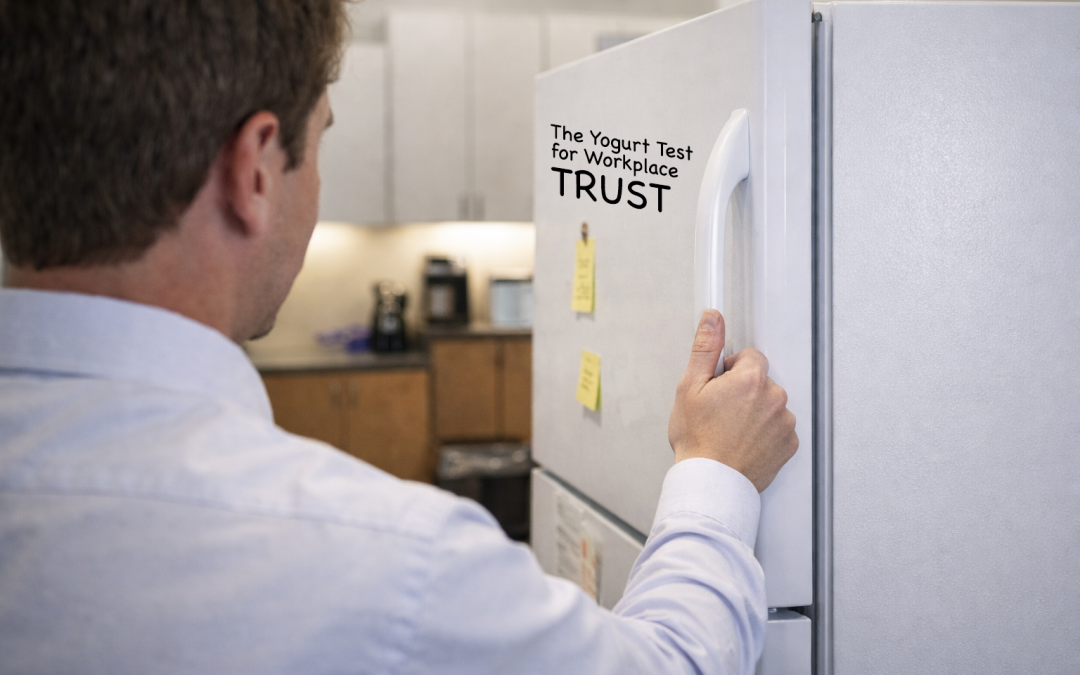
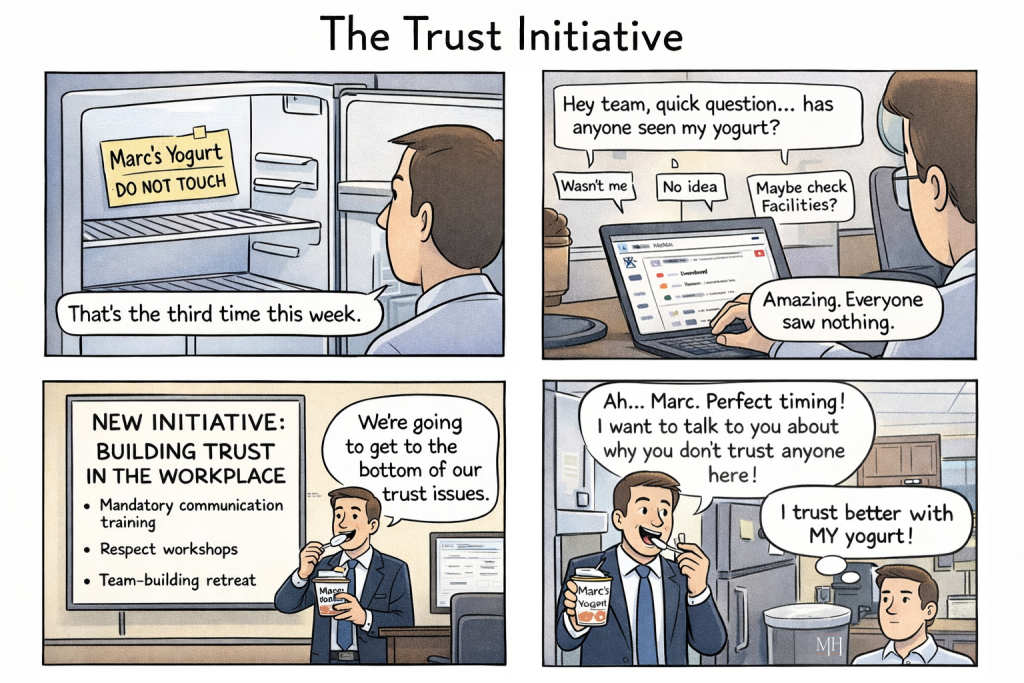
Let me paint you a picture. It’s 9:07 AM. You’re on your third Slack message to a colleague who was “just about to reply.” The all-hands meeting starts in three minutes, and someone—we don’t know who, but we all know who—has once again eaten your clearly labelled yogurt from the fridge.
And yet, we wonder why trust in the workplace is hard to build.
As someone who has spent years helping organizations rethink how they treat the people who power them—both employees and customers—I can tell you this: trust is not a vibe. It’s not a mood board. And it is absolutely not a ropes course in the woods.
A recent synthesis of 10 academic studies on workplace trust gave me a lot to work with. I’m going to share the most important findings with you right now—with all the enthusiasm of a late-night host who just got handed a really juicy memo.
1. Communication: The Thing Everyone Does Badly and Blames on Email
Here’s a finding that will shock absolutely no one: poor communication is the #1 cause of trust falling apart at work. And yet, here we all are—sending passive-aggressive reply-alls and wondering why nobody feels safe sharing ideas.
The research is clear.
When communication breaks down, trust doesn’t just take a hit—it bleeds out across the entire organization. Like a bad rumour at a high school, distrust spreads fast and sticks around long after the original drama is forgotten.
But here’s the part I love: it’s not just about being “nice.” One study found that how often people talk to each other actually changes how trustworthy they seem. Talk to your colleagues more—even briefly, even about mundane things—and they will literally perceive you as more credible. This is science, people. Use it.
“Employees who felt valued and supported by colleagues were more open to communicating, giving feedback, and collaborating. Those who didn’t? Miscommunication, conflict, and a productivity nosedive.”
The takeaway for experience strategists is simple: communication isn’t a soft skill. It’s an operating system. When it fails, everything else fails with it.
2. Fairness: Wild Concept, Enormous Impact
Let’s talk about organizational justice. That’s a fancy way of saying: do people feel like things are fair around here?
A study of over 350 teachers found that when leaders distributed resources fairly and made decisions through clear, consistent processes, something unexpected happened: teachers began to trust each other more. Not just the boss—each other. The fairness “trickled down” from leadership into peer relationships, building what researchers called “collective responsibility.”
Translation: when people feel the system is fair, they stop guarding their turf and start helping each other. Which, if you think about it, is the whole point of having a team.
This is why experience strategy at the organizational level matters so much.
You can’t bolt trust onto a broken foundation. Fix the processes. Fix the resource allocation. Make decision-making transparent. The trust will follow.
3. Social Skills Are Learnable (And More Powerful Than You Think)
Here’s the finding that surprised even me, and I’ve been in this field long enough to be surprised by very little.
A systematic review of long-term care facilities found that for co-worker relationships to thrive, staff needed to be “able” (have the social skills), “willing” (have the right values), and “supported” (have good leadership). Sounds reasonable. Here’s the kicker: social skills were considered equal to or more important than willingness or organizational support.
In other words, you can care deeply about your colleagues and have the full backing of your organization, but if you don’t know how to navigate a tough conversation or read a room—trust is still going to be a struggle.
The good news?
Social skills are teachable. This isn’t about hiring people who are naturally charming (though that never hurts). It’s about investing in communication training, conflict navigation, and interpersonal development as a core part of your people strategy. Not a nice-to-have. Not a one-day workshop you forget by Thursday. A real, sustained commitment.
4. Control Freaks, This One’s for You
My personal favourite finding from this research—and I mean that sincerely—is this:
When organizations pile on too many restrictive policies, employees don’t just comply less. They build stronger bonds with each other by working around those policies together.
Researchers literally called these employees “partners in crime.” Sharing passwords. Passing along information that policy said shouldn’t be shared. Not out of malice—but because people needed to get their work done, and the system was getting in the way.
The more you restrict, the more you accidentally outsource trust from the organization to the peer group—and suddenly the company’s goals and the team’s informal rules are pointing in completely different directions.
This is a critical insight for anyone designing employee or customer experience. Rigid systems don’t create safety—they create workarounds. If you want people to trust the organization, you have to design systems that actually enable people to do their jobs. Autonomy isn’t the enemy of accountability. More often, it’s the engine.
Check out this podcast
5. One Size Does Not Fit All (Looking at You, Mandatory Icebreakers)
Here is where I will save you from a very expensive mistake: the trust-building strategy that works for your 25-person startup will absolutely not work for your 5,000-person enterprise. And vice versa.
One study found that team sports were a fantastic trust-builder in a 26-person financial services firm. Another found that structured fairness policies were essential in a school with 354 teachers. Both worked—in their contexts. The difference is scale and formality.
Small organizations can build trust through casual, informal interaction because people run into each other all the time. Large organizations can’t rely on spontaneity—they need systems, structures, and deliberate policies to create the same conditions.
The practical framework I use with clients involves three questions.
- How big and formal is the organization?
- How much autonomy do employees actually have?
- What does the workforce actually need—more leadership support, more skill development, or both?
Get honest answers to those three questions, and the right trust-building approach becomes much clearer.
So What’s the Payoff? (Glad You Asked)
I know what some of you are thinking. “This all sounds great, but what’s the business case?” Fair. Here’s what the research actually shows happens when trust goes up.
- At the individual level, people stay longer, feel more committed, and are less stressed.
- At the team level, cooperation goes up, conflict goes down, and performance improves.
- At the organizational level, productivity increases, culture improves, and you spend less money on expensive control mechanisms that weren’t working anyway.
In short: trust is not a soft, feel-good initiative. It is a hard business driver. And organizations that treat it as such—with the same seriousness they bring to quarterly targets—are the ones that will build cultures people actually want to be part of.
The Bottom Line
Workplace trust doesn’t come from a single program, a catered lunch, or a leadership retreat where people share their spirit animals. It comes from consistent communication, fair systems, teachable skills, and the wisdom to know when to loosen the grip.
The yogurt thief in your office is a symptom, not the problem. The problem is almost always a system that hasn’t been designed with human beings at the centre of it.
That’s where I come in.
About the Author
 Marc Haine is a customer and employee experience strategist, keynote speaker, and founder of Elite Headline Speakers, where he helps meeting planners curate the best speakers in the business to create jaw-dropping, show-stopping events their attendees rave about long after the lights go down.
With over 30 years in events, hospitality, leadership, and customer-facing industries, Marc blends real-world experience with a theatrical flair—thanks to his best-selling book, Lights! Camera! Action!: Business Operational Excellence Through the Lens of Live Theatre. He’s also the host of Marc Haine Live and Experience Leadership: The Small Business Podcast, where he uncovers practical tools for leaders and business owners to elevate their teams and culture.

Marc is known for his energetic delivery, quick wit, and ability to turn everyday challenges into “aha” moments. His mission is simple: help organizations create meaningful experiences—on stage, on site, and in every engagement that matters.
When he’s not speaking or coaching, you can find him designing better attendee journeys, hunting for exceptional speakers for planners, or reminding event volunteers that smiling is technically part of their job description.