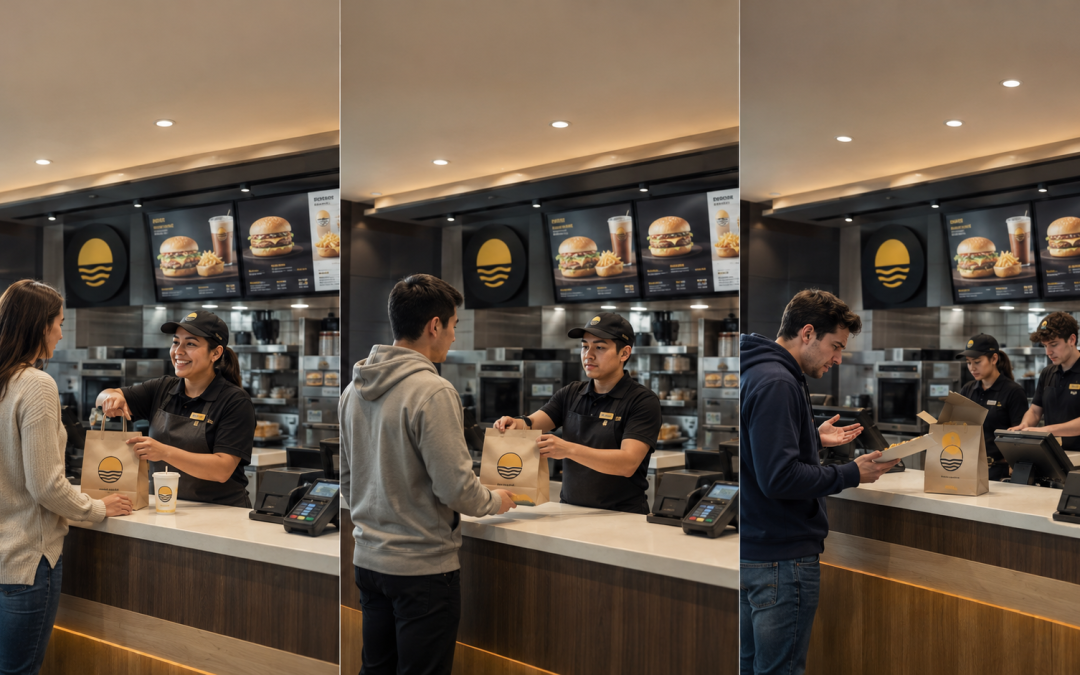
Why Franchise Customer Experience Lives or Dies on Consistency
Customer experience, especially franchise customer experience, is built one interaction at a time — and one executive recently decided to test that in the most public way possible.
Imagine publicly sharing your personal phone number with customers.
Now imagine those customers have opinions about burgers.
Lots of opinions.
That is what Burger King U.S. and Canada president Tom Curtis did. According to QSR Magazine, Curtis publicly released his phone number and received tens of thousands of calls and messages from guests. He responded to many of them personally and listened to feedback about everything from menu ideas to store-level service problems.
It was bold.
Most executives have enough trouble keeping up with emails from people they already know. Curtis invited an entire continent to contact him about mayonnaise.
Still, the experiment revealed something important. Customers were not simply asking for new products or bigger promotions. Many wanted a more consistent, accurate, and welcoming in-restaurant experience. They wanted their food prepared correctly, their requests followed, and someone available to help when things went wrong.
In response, Burger King announced two initiatives.
The first is the “Your Way Champion.” A reimagined restaurant manager role designed to welcome guests, double-check orders, support customization, and resolve concerns in real time.
The second is the “Whopper Guarantee.” If a customer is dissatisfied with their Whopper, the restaurant will remake it. Customers can also scan a QR code to receive a free Whopper on a future visit.
There is much to admire here. Burger King asked for feedback, listened to what customers said, and took visible action.
There is also a larger issue hiding inside the wrapper.
Why does a business need a special program to deliver what customers believed they were already buying?
Every Franchise Customer Experience Ends With One of Three Responses
In my book, LIGHTS! CAMERA! ACTION!, I explain that every customer experience produces one of three reactions.
The first is:
“Oh, wow. That was great.”
Something memorable happened. An employee anticipated a need. A manager solved a problem with care. The organization made the experience easier, warmer, or more personal than the customer expected.
These are the moments people talk about. They become stories. They create referrals, positive reviews, and loyalty.
The second reaction is:
“Oh, what a shame.”
The experience fell short. The order was wrong. The room was dirty. The employee was indifferent. The organization made a promise and failed to keep it.
The customer may complain. They may leave a review. Or they may simply disappear, which is often worse because the business never learns why.
Then there is the third response:
Nothing at all.
The business delivered what it promised. Nothing more. Nothing less.
The order was right. The room was clean. The appointment started on time. The employee was polite. The product worked as expected.
No fireworks. No parade. No emotional support marching band.
The experience was completely forgettable.
At first glance, that sounds like failure. After all, customer experience experts often tell businesses they must be remarkable. They encourage companies to exceed expectations and create “wow” moments.
I agree with that ambition. But we must not confuse memorable with dependable. Sometimes forgettable is exactly what the customer needs.
Consistency Creates Confidence
Customers do not need every routine interaction to become a life-changing event.
If I order a burger without onions, I do not need the restaurant team to gather around the counter and perform a dramatic reading of my receipt. I need them to leave off the onions.
If I check into a hotel after a long day of travel, I do not need the front desk employee to make me feel as though I have arrived at the palace. I need the room to be clean, the key to work, and the person in room 214 to stop practising the tuba by midnight.
There is enormous value in getting the basics right.
That is the heart of franchise customer experience: getting the routine right, every single time.
The Franchise Variable: One Brand, Many Experiences
Consistency creates confidence. It tells customers they can return without taking a gamble. It reduces anxiety and effort. It makes the brand feel safe.
That is especially important in franchise businesses.
A franchise brand may have one name, one logo, one menu, and one national marketing campaign. But the customer experience is delivered by different owners, managers, and employees (with different training) across tens, hundreds or thousands of locations.
One location may be run by an experienced operator with a stable team. Another may be short-staffed, undertrained, and relying on one assistant manager who has not sat down since February.
The sign outside is identical.
The experience inside may not be.
For the customer, however, those distinctions mean very little.
They do not say, “That was a disappointing experience, but I understand this location is independently owned and operated, so I will carefully restrict my frustration to the local franchise entity.”
They say, “Burger King was terrible.”
Or, “That hotel chain has gone downhill.”
Or, “I will never use that company again.”
One location makes the mistake. The entire brand receives the blame.
That is the central challenge of franchise customer experience: corporate creates the promise, franchisees operate the business, managers interpret the standards, employees deliver the experience, and customers judge the whole brand based on individual interactions.
It is the business version of live theatre. The audience does not care which cast member missed rehearsal or which technician forgot to check the microphone. They bought a ticket to the show.
A Guarantee Is Not the Same as Reliability
Burger King’s Whopper Guarantee is a service recovery program.
Service recovery is what happens after the business disappoints the customer.
Done well, it can preserve trust. A quick apology, a sincere response, and a fair solution can convince the customer to give the business another chance.
But recovery is not the same as reliability.
Under the new guarantee, Burger King will remake the customer’s Whopper and provide a QR code for a free one on a future visit.
That sounds generous. It may be enough to bring some customers back. But consider the journey from the guest’s perspective.
They must notice the mistake, bring it to someone’s attention, wait for the replacement, scan the code, save the offer, return to the restaurant, and redeem it.
The business made the mistake.
The customer received homework.
A free product does not erase the original frustration. It simply buys the brand another audition.
The best service recovery process should reduce customer effort. It should also trigger a deeper operational question: why did this happen in the first place?
Was the employee poorly trained? Did the restaurant lack enough staff? Was the order system confusing? Had the menu grown too complicated? Was the manager buried in paperwork? Were employees being pressured to prioritize speed over accuracy?
A complaint should never be treated as an isolated annoyance to be closed as quickly as possible.
It is evidence.
It tells the business where the promise is breaking down.
Be Careful About Branding the Basics
The Your Way Champion could be a valuable idea. Customers often become frustrated because they do not know who has the authority to solve a problem. A clearly identified leader who can step in quickly may reduce that friction.
But we should also acknowledge the obvious.
Welcoming guests, checking orders, supporting employees, and resolving concerns are not revolutionary additions to the restaurant manager’s role.
They are the restaurant manager’s role.
This is exactly where franchise customer experience is won or lost — in the ordinary, unglamorous moments of daily operations, not in a new title.
Creating a special title and uniform may bring needed attention to the guest experience. It may also reveal how far the operation has drifted from the fundamentals.
Imagine a hotel announcing a new “Clean Room Champion.”
You might appreciate the commitment.
You might also sleep in your clothes.
Accuracy, cleanliness, responsiveness, and courtesy are not premium upgrades. They are the price of admission.
There is also a danger in assigning the customer experience to one person. When one employee becomes the official champion, everyone else may quietly decide that customer care is no longer their responsibility.
A cashier sees an unhappy guest and thinks, “The Champion will handle it.”
The kitchen assumes the Champion will catch mistakes.
Other managers focus on administration because someone else now “owns” the customer.
Soon, the Champion becomes a bottleneck, sprinting around the restaurant like a superhero whose only special power is being interrupted.
Why One “Champion” Isn’t Enough
The best customer experience cultures do not depend on one hero. They create shared ownership.
Every employee should understand the brand promise. Every team member should recognize when it has been broken. Frontline employees should have enough authority to solve reasonable problems without launching a search for the manager.
Empowerment is not telling employees to “use good judgment.”
It means defining what good judgment looks like, establishing clear boundaries, and supporting employees when they act.
Training Cannot Repair a Broken System
Burger King has said it will invest in training and provide restaurants with more resources. That is encouraging.
But training is often treated as the universal cure for every customer experience problem.
It is not.
No amount of training fixes a franchise customer experience that is broken at the system level.
You cannot train employees out of chronic understaffing.
Coaching will not fix broken equipment.
And no pep talk will inspire a manager to spend more time with guests when that same manager is already responsible for hiring, scheduling, inventory, payroll, food costs, reports, online reviews, and covering three missing shifts.
Sometimes the employee is not the problem.
The system is.
Franchise brands must examine whether their operating model supports the experience their marketing promises.
Are staffing models realistic? Do standards hold up under real conditions? Does onboarding properly prepare and support franchisees? Do managers learn to lead people, or merely follow checklists? Do frontline employees have the authority to resolve small problems? Does the reward structure recognize only speed and sales, or also accuracy, retention, and customer effort?
If employees are rewarded for moving faster while customers expect accuracy, accuracy will eventually lose (you know the adage… “haste makes waste!”)
If managers are drowning in administration, handing them a new uniform and asking them to spend more time with guests will not solve the problem.
A new costume cannot repair a weak production.
Consistency Is the Platform for “Wow” in Franchise Customer Experience
The choice is not between consistency and exceptional service.
You need both.
Consistency protects the customer from disappointment. Exceptional moments give them something worth remembering.
The mistake is trying to create surprise before the basics are secure.
A handwritten thank-you note is a lovely touch. It becomes less charming when it is attached to the wrong order.
A loyalty program may generate repeat visits. But no number of points will make customers loyal to an experience they cannot trust.
The strongest customer-facing businesses build their reputation in layers.
First, they deliver the promise.
Then they make that delivery easy and dependable.
Finally, they look for appropriate moments to exceed expectations and create the “Oh, wow” response.
That order matters.
You cannot build remarkable experiences on an unreliable foundation.
What This Means for Burger King’s Initiatives
Burger King deserves credit for listening to its customers and responding. The Your Way Champion may make it easier for guests to find help. The Whopper Guarantee may encourage disappointed customers to return.
But uniforms, QR codes, and media announcements will not determine the success of these initiatives.
A busy lunch rush will — when the restaurant is short-staffed, orders are piling up, and no senior executive is anywhere near the building.
That is where the brand promise lives.
Your customers do not experience your advertising campaign, your mission statement, or the beautifully framed values hanging in the head office.
They experience your operation.
They experience your people, systems, staffing, standards, and leadership. They experience whether your business makes things easy or exhausting. They experience whether the promise is delivered at one location, some locations, or every location.
A guarantee tells customers what you will do after you disappoint them.
Consistency makes disappointment less likely in the first place.
And that is the real brand promise.
Every customer.
Every employee.
Every location.
Every time.
Marc Haine

Marc is a service expert and a master of experiences. He's also an author, speaker, facilitator and coach. He will help your teams ignite their passions, enable your leaders to recentre their focus, and drive continuous improvement through connected and engaged employees. This will allow you to realize your competitive advantage with a connected purpose and consistency of customer experience across your brand. He will dare your people to cultivate a generous attitude and lead with love and kindness first.