
Employee Engagement Is Down. We’re Fixing the Wrong Problem
Gallup’s latest findings are a warning to business leaders about employee engagement. But the answer isn’t another campaign asking employees to be more enthusiastic. It begins with the experience we’ve designed for them.
I once found myself arguing over a plate of food that hadn’t even been cooked.
During the expansion of Edmonton’s Palace Casino, back in 2001, one proposed plan had food travelling from an upstairs kitchen to an entertainment lounge downstairs. Roughly 200 yards separated the kitchen from where guests would eat. A dumbwaiter was even discussed, although it couldn’t make the distance or the service problems vanish.
Think of the journey. Someone prepares the meal. Someone has to get it across the building, keep it hot and make sure it reaches the right guest. And when it arrives late or cold, who gets the complaint? The server, of course. The employee who didn’t design the route gets to explain why dinner took the scenic tour.
Thankfully, we hadn’t built that system. But it exposed a habit I still see in businesses: we create obstacles for employees, then hold them responsible for getting around them. When they grow tired of doing that, we call it an engagement problem.
Maybe the problem isn’t that people have forgotten how to care. Maybe we’ve made caring a lot harder than it needs to be.
The Numbers Should Make Us Uncomfortable
On October 28, 2026, Gallup reported that just 29% of U.S. employees were engaged in the third quarter. That’s the lowest level since 2011. Another 53% were not engaged, and 18% were actively disengaged.
Those are different groups. Someone who isn’t engaged is not necessarily angry, lazy or planning a dramatic exit. But they lack a strong connection to their work and employer.
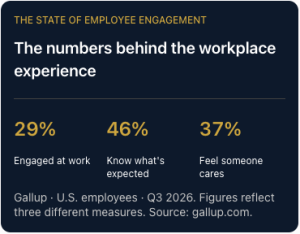
Two findings matter even more to me. Only 46% of employees strongly agreed that they knew what was expected of them at work. Just 37% strongly agreed that a supervisor or someone at work cared about them as a person. Both figures had fallen from the first half of the year.
Read those questions without the management language.
Do I know what I’m supposed to do?
Does anybody here care about me?
We’re talking about the basics of a decent working relationship. And apparently, even those basics are proving difficult for many organizations.
Canadian leaders shouldn’t assume this is someone else’s problem. Gallup’s 2026 country data put engagement in Canada at 21%, based on a three-year rolling average ending in 2025. That isn’t directly comparable with the latest U.S. quarterly figure, but it’s hardly cause for a victory lap.
Gallup’s numbers are a warning, not a diagnosis for every workplace. They don’t tell us that every disengaged employee has a poor manager or that every problem can be fixed by changing a process. Pay, job security, workload, respect and the nature of the job all matter. The results should make us curious about what employees experience each day.
And curiosity is a much better starting point than another motivational poster.
We Keep Treating Employee Engagement Like a Program
I have watched organizations put enormous care into designing the customer’s experience, then leave the employee’s experience to chance. We plan the greeting, map the customer journey and debate how quickly the phone should be answered. Behind the scenes, staff use workarounds, wait for approvals and spend half a shift trying to find information that should have been available in the first place. Then we ask why they aren’t more committed.
Imagine the employee who has an idea to improve the service. We say we welcome suggestions. Wonderful! There’s a form to complete. The form goes to a committee. The committee meets next quarter. And at the next staff meeting we ask why employees aren’t taking more initiative.
We’ve turned an invitation to contribute into an obstacle course. And we wonder why people stop entering.
Recognition matters. A staff celebration can be terrific. I’m from hospitality; I will never declare war on a good buffet. But a free lunch won’t repair a schedule that changes without warning, a supervisor who talks down to people or a rule that makes it impossible to help a customer.
My point isn’t that employees deserve a friction-free day. Work is work. Sometimes it’s busy, demanding and downright unpleasant. My point is that leaders should know the difference between the challenges that come with serving customers and those we created through poor decisions.
Engagement is not something we can demand. It’s an outcome of the experience people have while working for us. And those experiences are shaped by far more than the annual survey.
The 200-Yard Lesson
At the Palace Casino, we were working from a belief that guests came to gamble, and food was simply there to support them. Food had even been described within leadership as a “necessary evil.” Once that belief took hold, it shaped almost every choice about the operation.
But when I looked more closely at who came to the casino and why, I saw something different. Some guests, including older regulars, treated the casino as a social gathering place. They wanted somewhere to meet, eat, relax and feel welcome. A good meal wasn’t a distraction from the experience. It could be part of the reason they came.
I argued for a different layout: a main-floor deli to serve breakfast and daytime guests and support the nearby lounge in the evening, with an upscale-casual Steakhouse upstairs as a destination restaurant. It took some convincing, but the plan was approved.
The important point isn’t that I won an argument over a floor plan. It’s that our original assumption about the customer had led us toward an operation that could make employees’ jobs harder. When we changed the assumption, we could design a better experience for both.
Consider what a poor handoff costs:
- A customer waits.
- An employee must explain the delay.
- Someone rushes to fix it.
- Another person stops what they’re doing to help.
The customer may leave with less confidence in the business, while everyone behind the scenes works harder just to deliver what was promised. No single mistake looks enormous, yet repeat it every day, and you’ve built waste into the operation.
We didn’t measure employee engagement before and after the Palace decision, so I won’t claim the redesign improved a survey score. What it did was change how I thought about leadership. Why ask employees to perform heroics to overcome a problem we could remove?
The Show Starts Backstage
In my book, LIGHTS! CAMERA! ACTION!, I use live theatre to explain how businesses operate. The audience sees the performance. They don’t see the rehearsal, the lighting cues, the handoffs or the people backstage making sure the show stays on track. But if those things fail, everyone notices, especially the person standing in the spotlight.
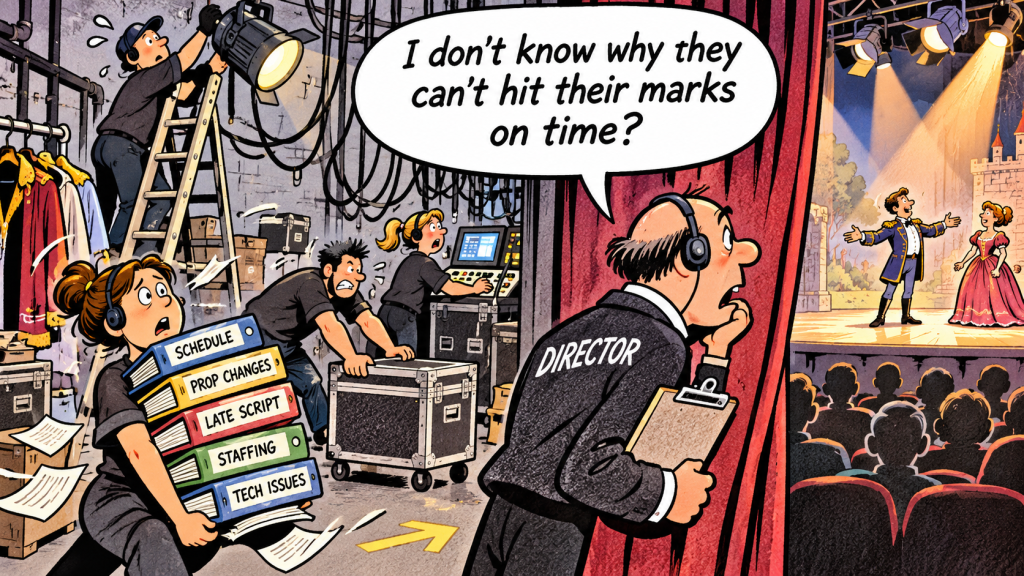
If processes are chaotic and hectic, how can employees perform to their full capacity?
The same is true at work. We want employees to provide a remarkable customer experience. Fine. What experience have we created for the people expected to deliver it?
LIGHTS! is about the promises that guide the organization. What do we stand for? What does that mean when a customer is upset or a worker needs help? Values aren’t what we print on the wall. They’re what people can count on when a decision gets difficult. If we say we value families but keep changing schedules at the last minute, employees will believe the schedule, not the poster.
CAMERA! brings the real work into focus. Look at every point where employees meet the business: recruitment, the first shift, training, a request for support, a handoff between departments or a conversation with their manager. Do they know what success looks like? Can they get the tools and information they need? Are they trusted to solve reasonable problems? If we wouldn’t accept a confusing journey for our customers, why have we accepted one for our employees?
ACTION! is what happens when the doors open. A new hire makes a mistake. A customer complains. Someone challenges an old policy. In those moments, employees learn whether leaders will support them, coach them or leave them alone to take the heat. A business can have beautiful values, sound training and great systems. Yet one leader who punishes honest feedback can undo a lot of that work.
These three parts must agree. You cannot promote trust while managing every decision through suspicion. You cannot celebrate service excellence while refusing to give employees the authority to serve. And you cannot expect a polished front stage if the backstage is chaos.
Managers Need Support, Not Another Impossible Assignment
Front-line and middle managers shape much of the daily employee experience. But too often, they’re handed responsibility without the authority to act. They must improve morale, control labour, handle customer complaints and coach the team, while major staffing, pay and technology decisions happen somewhere else.
Gallup’s 2026 global report found that manager engagement was 22% in 2025, down from 31% in 2022. That should give senior leaders something to think about before assigning managers another engagement target.
Train managers to set expectations, give feedback and handle difficult conversations. Then examine what you’re asking them to carry. Are their schedules realistic? Can they make decisions? Do they have time to coach, or are they filling gaps all day? Giving managers an impossible job and telling them to inspire everyone else is not a strategy.
The same test applies to technology, including AI. Gallup found sharper recent engagement declines among remote and hybrid employees, especially in organizations adopting AI. That doesn’t prove AI caused the declines. It does raise an important question: are we changing the work faster than we’re helping people understand it? A new tool isn’t a plan if no one can explain what it changes, what success looks like or where employees can get help.
Start With One Workday, Not Another Campaign
If you want to tackle low engagement, here’s where I’d begin.
Pick a team and follow its work for a day. Not a tour where the boss arrives, everyone smiles and the staff mysteriously discover their best manners. Watch the busy hour. Observe the handoffs. See what happens when someone makes an honest mistake or asks for help.
Ask employees what makes their jobs harder than necessary, what they keep working around and which single change would help them do better work. Then listen without arguing. Explaining why a broken process was once a brilliant idea won’t make it less broken.
Choose one fix. Give it an owner and a date. Perhaps it’s a clearer instruction, a better handoff, a fairer schedule or permission to solve a common customer problem. Follow up with employees and customers. Did waiting time fall? Are errors or repeat complaints declining? Do employees report clearer expectations? If it didn’t help, learn and try again.
Don’t use a small process fix as an excuse to avoid a large problem. Unsafe conditions, unfair treatment, chronic understaffing and poor pay call for real decisions, not a cheerful new poster. The goal is to make daily work more honest, fair and effective, and to keep improving it together.
Here’s the challenge I’d put on every leader’s desk. Tomorrow, ask one employee, “What makes your job harder than it needs to be?” When they answer, ask yourself a tougher question: “What have I done to fix it?”
If the answer takes you back to a policy, a handoff or a dinner travelling 200 yards through a building, you’ve found somewhere useful to start.
Because perhaps low engagement isn’t only a problem employees need help solving.
Perhaps it’s also the report card leaders have been avoiding.
Marc Haine

Marc is a service expert and a master of experiences. He's also an author, speaker, facilitator and coach. He will help your teams ignite their passions, enable your leaders to recentre their focus, and drive continuous improvement through connected and engaged employees. This will allow you to realize your competitive advantage with a connected purpose and consistency of customer experience across your brand. He will dare your people to cultivate a generous attitude and lead with love and kindness first.